
Welcome back to another blog hop, with #OpenBook. Here’s this week’s prompt.
Don’t forget to click the link to see what everyone else has to say on this week’s subject. It’s at the end of my post.
Tell us about an iconic or weird object in your home.
Here’s something you don’t see in every house. For several years of my working life, it was the most important thing I owned.
It would not be too much to say that people’s lives depended on it, and my ability to use it.
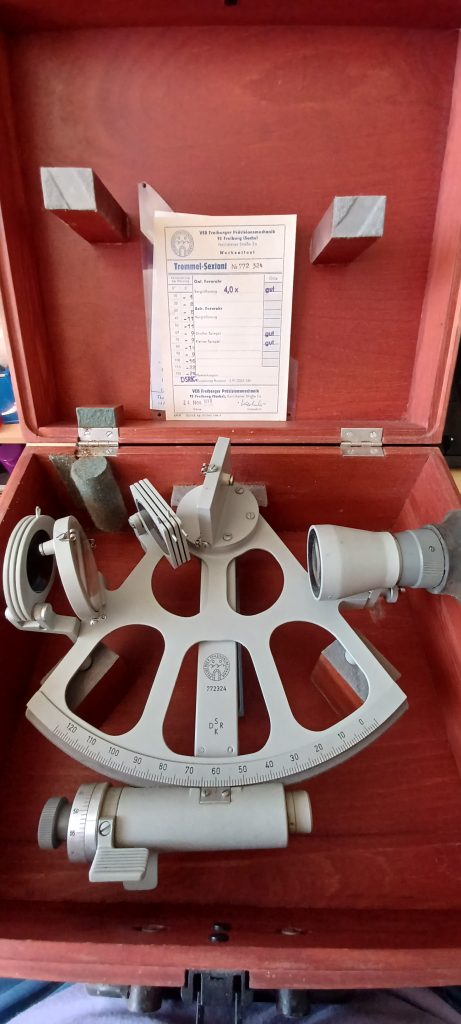
You might (or might not) recognise the contents of that simple wooden box. It’s my trusty sextant. One of the more important tools of my trade.
The story behind it started in 1979.
That was the year I completed all the qualifying conditions to hold a Certificate of Competency as Second Mate (Foreign Going) in the Merchant Navy.
Which meant that I was considered competent to keep the middle watch (midnight to four a.m.) when at sea and to be responsible for planning and executing the safe navigation of any merchant vessel, anywhere in the world.
Back then, if you had a sextant, a chronometer, a nautical almanac and a set of sine/cosine tables, you could ascertain your position when out of sight of land.
The almanac gave you the positions of celestial bodies, the sextant allowed you to measure angles, the chronometer showed the exact time in Greenwich, while the tables were used for calculations in spherical trigonometry.
Of course, now it’s all done by satellite and provided as a real-time readout of Latitude and Longitude, or shown on a moving electronic chart in the ship’s wheelhouse.
Back in the 1970s and early 80s, that was still a way in the future. Even when the first satellite navigation systems appeared, they were unreliable and frequently incorrect. People didn’t trust them.
In those days, I always preferred to use my skill and experience to define the ship’s position.
As was the custom, on passing my Second Mate’s Certificate, I bought my own sextant. My choice was a Carl Zeiss Jena Drum Sextant, made by VEB Freiberger Prazionsmechanik of Freiberg, East Germany.
It was purchased from J. D. Potter Ltd, of the Minories, London and cost me more than a month’s salary (several hundred pounds, in 1979).
With that, I was all set. My trusty sextant helped me get around the planet for many years. And it always got me home.
Now, it sits in its box, in the corner of my office. Secure in the knowledge that it still knows its exact position.

What do you think about this week’s subject?
Let me know by leaving me a comment.
While you’re here, please click the InLinkz link to check out what my fellow writers have to say about this week’s topic.

I’ll be back with another post on Thursday, see you then. Meanwhile, have a great week.

I’d love to get your comments, please leave them below. While you’re here, why not take a look around? There are some freebies and lots more content, about me, my writing and everything else that I do.



Stevie Turner
I’ve always wondered how a sextant aids navigation, and you’ve given me an insight here, Richard. I still don’t know the ins and outs of it, but I’ve already figured out it’s beyond my elementary maths knowledge. Interesting though!
Richard Dee
I hated maths at school. Celestial Navigation was a subject I enjoyed and found easy. I think it was because it was not the abstract concept of solving problems for the sake of them, it had a practical (and useful) application.
P.J. MacLayne
It’s a beautiful piece of Equipment.
Richard Dee
I occasionally pick it up and remember when it, and I, were a team.
Lela Markham
I knew what it was before you identified it because it’s part of the survey equipment our crew uses to build roads. A lot of the older guys prefer it over what they call “the magic stick” which does all the thinking for them.
Compasses don’t really work in Alaska — we’re too close to the geographic pole so our compasses all point about 23 degrees off true north. And, because so much of Alaska hasn’t been surveyed yet, GPS doesn’t work really well either. It’s getting better, but when GPS first came out a couple of decades ago our Garmin would tell us our latitude and longitude and nothing else. Today, my cell phone will give me a vague map of vast swaths of the state. GPS are better than my phone, but they still don’t work for Alaska.
Hence why, when planes go down here, they’re almost never found. More are found today with the transponders, but still….
I love old equipment like that and, well, obviously, the older surveyors at work think they’re more accurate than the “magic stick.”
Richard Dee
It’s a clever bit of kit that has been around for hundreds of years, in one form or another. And if there’s a power cut, who cares?
Kelly Williams
Oh, wow! That’s incredible! A fascinating tool. It must be such a thrill to use something that mariners have trusted for centuries. The long history there behind you and others. Fantastic piece!
Richard Dee
It certainly gave you a buzz when your first sight of land was exactly when and where your calculations had predicted. Especially after crossing an ocean.